Wednesday, 3 August 2011

Local vs Global Pizza


While reading the latest issue of Audubon magazine, I was inspired by a project conducted by San Francisco university students curious about the sources of their food. These students found some tacos at a local food truck and then traced the origins of everything that went into each taco.  To their surprise, these California tacos were made from ingredients as far as Northern Thailand.  This got me thinking, even in areas where we can find an abundance of locally grown food, we are often tempted by price, habit, convenience, or curiosity to purchase food from global sources.


To understand our ‘eating’ footprint, my partner and I challenged ourselves to make a meal from as many local ingredients as possible and compare the result to a more typical meal derived from conventional ingredients.  We chose a meal we both enjoyed while allowing us to get creative: Pizza.  Because some of the more common products available at our farmers market (like sweet potatoes, onions, and fresh fruit) don’t necessarily belong on your typical pizza, we thought it would be an interesting challenge.
We chose the local ingredients based on what was available at the weekly farmers market and compared this “Local Pizza” to one of our conventional Friday night pizzas, a.k.a. “Global Pizza” – all of which were homemade.  We made two local pizzas but I only did the math on one.  To get the distances of the grocery store ingredients, I checked product labels and e-mailed the companies.  For our local pizza, I talked to farmers to find out where their farms were.

Here is what we found:

Approximately how far did our ingredients travel?

(Distances are best possible approximations, and I’ve used miles considering I’m currently in the U.S.A.)


To give you an idea of the cumulative distance the ingredients in our Global Pizza traveled, it was almost equal to flying across Canada three times (from Vancouver to St. Johns Newfoundland), or making the trip between Seattle and Miami more than three times! Assuming the trucks that brought our ingredients get 15 miles per gallon, our Global Pizza used 574 more gallons of fuel than our Local Pizza. Although this is a simplification, it gives us a general idea.


Here is the breakdown:

Mozza, Mushroom, Olive "Global Pizza"
Global Pizza 

997 miles
Mozzarella cheese: La Farge, Wisconsin

879 miles
Mushrooms: Kennett Square, Pennsylvania

4,565 miles
Olives: Product of Spain

2,296 miles
Pizza Sauce (organic, canned): San Joaquin Valley, California


Local Pizza 
Red pepper, Tomato, Ricotta-like Cheese "Local Pizza"

12.8 miles
Goat Cheese: Notasulga, Alabama

43.9 miles
Peppers: Fort Mitchell, Alabama

34.7 miles
Tomatoes: Shorter, Alabama

34.7 miles
Pizza Sauce (made from ingredients at the market): Shorter, Alabama

Although not the goal of this specific challenge, we did not notice that our local pizza differed from the conventional in terms of garbage produced. Here’s the breakdown:

Local: Plastic wrap on cheese

Global: Plastic from cheese, plastic from mushrooms, 2 aluminum cans (olives, pizza sauce).

Now, to the question that is on all of your minds: How did the local pizza taste compared to one derived from grocery store ingredients?

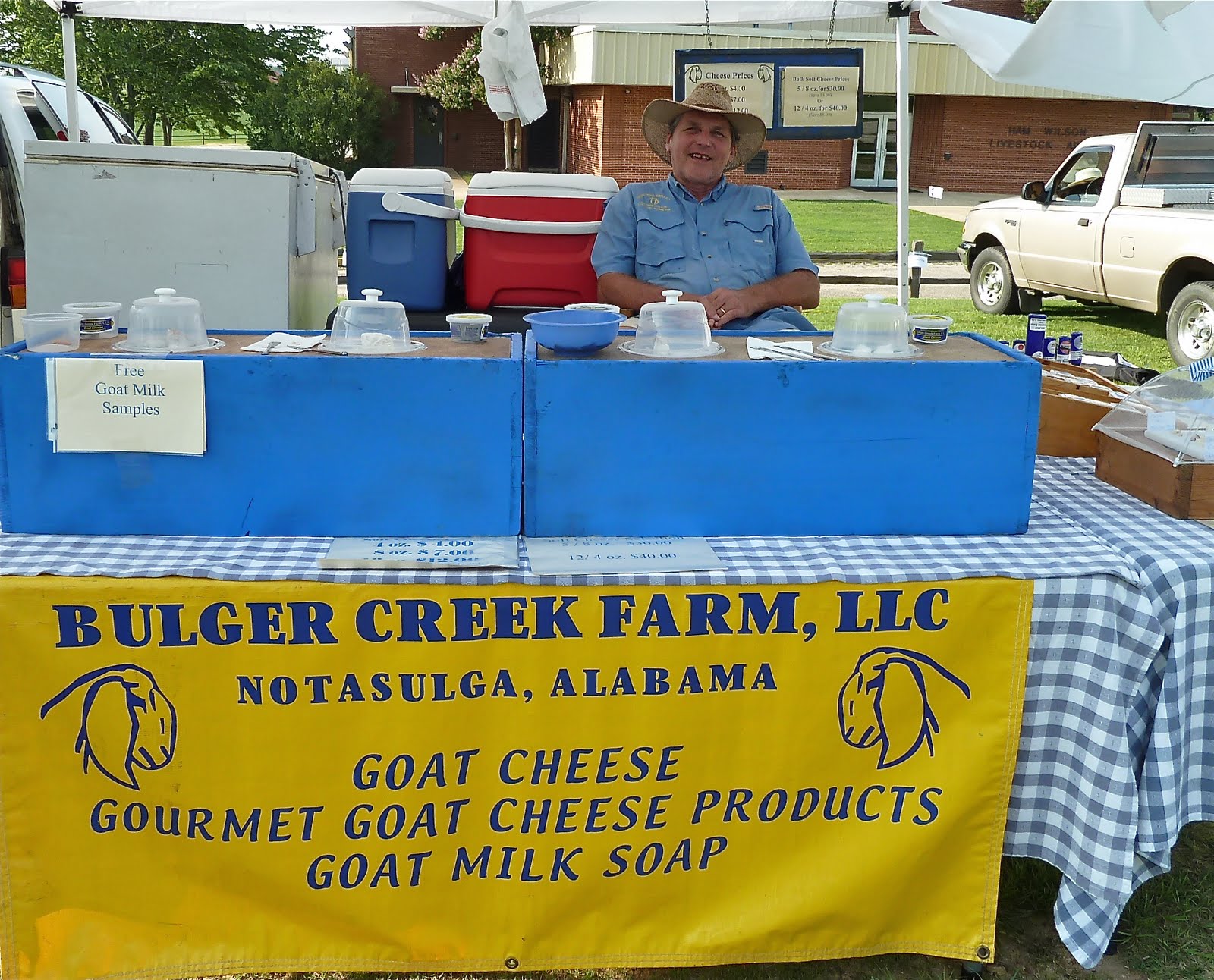
Bulger Creek Goat Cheese
Although we found it hard to make straightforward comparisons because the two pizzas we created were so different, we were pleasantly surprised at our local creation.  Our favorite local pizza was the roasted red pepper and goat cheese creation, made possible from a donation from Bulger Creek Farms (you can find them throughout south-central Alabama but we purchase our cheese at Auburn University’s Market at Ag Heritage Park).  Bulger Creek has done a great job of creating goat cheese in diverse forms and tastes, and with the added benefit of being made close to home and made with no preservatives.  Although most of you would probably be apprehensive to leave mozzarella behind, we had our pick of a ricotta-like cheese, goat feta, and even goat cheddar.  All have performed excellent on past pizzas.

To our surprise, we had an unexpected dinner guest that night.  We offered him his choice of the roasted red pepper or potato, eggplant and goat cheddar pizza, while warning him not to expect a traditional New York slice.  Whether he was humoring us or not, he seemed to have enjoyed both as well as the idea of ‘local pizzas’.  I think his preference would have been a meat option, so I was happy to report that the market also had a wide selection of grass-fed meats coming from farms less than 20 miles away.  Although this time we went vegetarian, we do have our eye on the rabbit sausage for a future local pizza!


Sources

Lowe, M. 2011. Global Taco. In: Audubon (July – August), pp. 16. 


Thursday, 28 July 2011

The Fish You Just Ate May Be More of a Globetrotter Than You Are

David Steen
This post is a contribution from David Steen. David A. Steen received his Ph.D. from Auburn University, his M.S. from the State University of New York-College of Environmental Science and Forestry, and his B.S. from the University of New Hampshire. He researches the ecology and conservation biology of wildlife and blogs about his work at www.LivingAlongsideWildlife.com. His copyrighted work appears here under a Creative Commons license.

The Fish You Just Ate May Be More of a Globetrotter Than You Are

Seafood is an integral component of southern culture, perhaps best exemplified by the platters of fried catfish on the menu in every hole in the wall restaurant from Brunswick, Georgia to Lake Charles, Louisiana.  And the Gulf of Mexico is renowned for its appetizing saltwater bounties, oil spill notwithstanding.  So, when I had a guest from out of town visit me in the Florida Panhandle, I was eager to show off all the region had to offer; almost immediately we headed to a local restaurant touting all-you-can-eat seafood.

    Considering my passion for both eating everything I can and local seafood, I didn’t think I had much need for a menu.  Almost as an afterthought, I asked the waitress what kind of fish I could expect to be piled in front of me, my head filled with fantasies of farmed channel catfish or perhaps, if I was lucky, some mackerel or snapper from the seas just to the south.  To my surprise, she didn’t know.  Briefly stepping away to yell into the kitchen, she returned with the verdict…Swai.

    “Swai?”

    As a vertebrate biologist, it’s not often I’m confronted with an animal I’ve never heard of, let alone when I’m sitting at the dinner table about to eat one.

    “And what is Swai?” I politely inquired.

    “It’s like a catfish, they farm it in Asia.”

    As I looked at the waitress and digested this new information, my eyes drifted around the restaurant, from the plastic crabs and fishing nets adorning the walls to the chalk boards advertising the price of Gulf shrimp and crawfish.  You mean to tell me, I thought to myself, this restaurant, named after a local seaside town, was shipping in something “like” a catfish from halfway across the world?  It turned out I would need that menu after all.

    When catfish was suggested as a potential alternative, I skeptically asked where it had originated; I was reassured when the waitress informed me it came from right here in Florida.  I’m happy to tell you it was delicious.

    Back at home, I decided to look into the curious case of Swai and spent some time researching the animal on the internet.  I learned this type of catfish, along with the closely related Basa, is native to a couple major rivers and their tributaries within southeastern Asia.  An important food source, the species is heavily farmed in ponds, particularly in Thailand and Vietnam.  Produced in mass quantities, the species represents a cheap source of fish, and that’s the reason it’s starting to show up in American markets.

    Catfish farmers in the United States have known about this trend for some time now.  Seeing their potential livelihood threatened by an inexpensive alternative, the catfish industry lobbied lawmakers for new regulations on the influx of Asian fish.  As a result of their efforts, it is now illegal for restaurants to sell Swai or Basa and call it catfish.  But they can still call it the Catch of the Day, feature it in their Fisherman’s Platter, or include it any other vaguely labeled dish. 

   Restaurateurs have a lot of freedom when writing the menu; along with fish distributors, they have been known to get creative in describing a particular species to make it sound more appetizing.  For example, the Patagonian Toothfish, Dissostichus eleginoides, is marketed in the United States as Chilean Sea Bass.  Which would you rather order, a Toothfish or a Sea Bass?

    I have no issue with eating Swai or Basa in general, although there are some concerns about how these fish are raised and questions regarding whether there may be health issues related to the associated farming practices; but I am an advocate for shopping locally.  Why ship anything across the planet, whether it’s a pair of pants or tonight’s dinner, when you can buy it next door?

(Courtesy of D. Steen)
    The next week, at another seafood restaurant, I was once again confronted with a dilemma.  The waves of the Gulf of Mexico lapped against the deck of the waterfront restaurant as both fishing and sightseeing boats motored by.  I took deep breaths of salt air between swigs from my beer as I watched the sunset.  It was the classic seaside scene.

    Perhaps it was the atmosphere, perhaps it was the beer, but it wasn’t until my Fisherman’s Platter arrived before I thought to ask what kind of fried filet would grace my plate.

    This waitress was better prepared, “Panaceas”. 

    Well, I wasn’t naïve about the name of this fish.  I knew it was a made-up label to make whatever I was really eating sound more palatable; it’s the same word we use to describe something that will solve all of our problems (Panacea is also the Greek goddess of healing).  But, at least it wasn’t Swai, I told myself.  And, I could reach out and touch the saltwater of the Gulf of Mexico from my table, what were the chances of eating a fish fillet that had been frozen and shipped thousands of miles before finally reaching my plate?  Surrounded by shrimp, scallops and French fries, I must confess to a moment of willful ignorance so I could enjoy the meal before me (it was fantastic).

    Something nagged at me though.  Back home, I returned to the internet to determine what kind of fish was being sold as Panaceas.  To my surprise, I couldn’t find any relevant hits.  On a hunch, I Googled Swai again for a closer look.  Realization slowly dawned over me as I slapped my forehead.  Both Swai and Basa are within the same genus, Pangasius.


    Want to learn the socioeconomic, human health, and environmental costs of the seafood you buy?  Check out the Smart Seafood Guide offered by the Food & Water Watch.  The Monterey Aquarium also offers handy pocket guides that recommend responsible seafood choices.  Live in Canada?  There's a guide for you too.