Showing posts with label Latin America. Show all posts

Tuesday, 31 December 2013

New Year's Eve Food Challenge: What Is This Fruit We've Been Eating Over The Holidays?


It's the holiday season and, for many of us, that means sharing food. I'm sure today, New Year's Eve, is no exception. In fact, I'm sure that the majority of readers have shared this mystery food at some point over the holiday. 

Readers, can you tell us the name of this fruit? 

If you're stuck, here are some clues:

How do you eat this fruit? This fruit is unique in we eat its pulp as well as its seeds. The pulp can be eaten raw but the seeds need to be roasted or at least dried in the sun before eating.

Where is this fruit from? It is native to Central America although it is grown all over the world in tropical areas. And, Ghana is one of the world's largest producers of this fruit.

Please share your answers in the comments section below!

Monday, 25 November 2013

Food Challenge: What is this Wild Fruit from Latin America?


This fruit is one of the most important foods used by Indigenous peoples in Latin America. Recent nutritional studies have described this fruit as a source of: protein, fat, powerful antioxidants, and many micronutrients, including selenium the nutrient famous for its mood enhancing potential. And, this fruit is not only enjoyed by humans but by animals such as chickens, squirrels, peccaries and paca.  

Readers, what is this fruit?

Please share your answers in the comments section below (if you have problems signing in to comment, let me know). Don’t forget to tell us how you learned about this fruit. If you’ve tried it, tell us what it tastes like too. 

Monday, 7 January 2013

Yerba Mate, Mate de Coca, what are they?


Yerba Mate, a tea made from the tree Ilex paraguariensis, met my palate this afternoon when I was searching for an alternative to my bottomless coffee cup. I found Yerba Mate on a list of loose teas offered at my local coffee shop. The name Mate brought me back to the year 2000. That year, I was also sitting in a coffee shop sipping Mate, albeit at a much higher altitude. I was in La Paz, Bolivia and there Mate is referred to as Mate de Coca. Mate de Coca is a refreshing and energizing tea made from steeping the leaves of a different plant, the infamous Coca plant (Erythroxylum coca). I'm indebted to the Bolivian Coca plant and one Bolivia lady who helped me cure an allergy with Coca leaves. The Bolivian lady taught me to bite the Coca leaves to release medicinal components and place them on my face where I suffered from this allergy, the picture below shows the severity. I was allergic to alpaca fur but I mistook my allergy symptoms for those of a common cold. As my allergies became worse, ironically, I kept warm by hiding in layers and layers of alpaca-fur coats and blankets. If I'm ever near Alpaca again, I'll carry Coca leaves with me!


I expected these two similar sounding teas to taste alike. To my surprise Yerba Mate tasted nothing like Mate de Coca. Unlike Coca's mild flavour, I found Yerba Mate to be bitter with a hard to describe aftertaste. For lack of a better comparison, the Yerba Mate aftertaste vaguely resembled the flavour of tobacco. 

Because I am fascinated by where plants come from I couldn't pass up the opportunity to find out what plant I was drinking. With the help of wikipedia's invisible scholars, I learned that Ilex paraguaiensis (Yerba Mate) is a forest plant found in the southern parts of South America, in Paraguay, Uruguay, Argentina, and Brazil. When you order a Yerba Mate, you are likely savouring leaves from tea plantations or from trees planted in their native forest habitats. Like the popular green tea, Yerba Mate leaves are processed before they hit your teapot. The main difference between Mate and green tea is the drying method. Mate is dried slowly using wood smoke and green tea is dried fast at high temperatures. 

Content to know what I was drinking, my curiosity turned to the human beings who first found this plant and decided it was good to drink. I'm rarely successful finding this type of information online, and this time was no exception. I'm convinced we rarely read about the people behind plants because those writing about ethnobotany are mostly  pharmaceutical researchers. As an ethnobotanist, I am often associated with pharmaceutical work too. For example, just in the last week a few people have assumed I work for a pharmaceutical company when I mentioned I'm an ethnobotanist. 

From the little information available, I read that Yerba Mate tea was first used by the Guaraní people of South America. I can't be sure of my sources, but it appears that when this tea was discovered by Jesuit priests, these priests tried to stop Indigenous peoples from drinking it (maybe because of its perceived demonic properties). However, the Jesuits that came in contact with Yerba Mate must have liked something about it because this tea made it all over Europe, quick. The desire for Yerba Mate is a story waiting to be told; I think it would make a good project for Michael Pollan and his work on the Botany of Desire

Although its medicinal properties were no doubt clearly known by the Guarani people, western science has found Yerba Mate to be good to treat parasites, high cholesterol, and inflammation; it also has caffeine in it so I guess this wasn't my best choice for a coffee substitute.


Tuesday, 16 October 2012

Eat Your Weeds


When I visit Canadian farmer’s markets in the fall, I’m sure to find an abundance of succulent orange yams. I imagined that I would be longing for this buttery treat now that I am living in Costa Rica. I was wrong. I found a tropical sweet potato substitute, the purple yam.

My Bribri friends introduced me to this yam substitute (called tu in Bribri, ñampi in Spanish, and Disocorea alata in Latin). Just as in Canada, yams are harvested here in the fall. Although purple yams don’t quite have the same texture or flavour of orange yams, both varieties are used in similar ways. I’ve eaten purple yam soup, fried yams, mashed yams, and, my favourite, boiled yams. Purple yams have a starchy texture similar to a yellow russet potato. Unlike the unique sweetness of an orange yam, the  purple variety tastes quite simple, with slightly more of a kick than a standard potato. 

The purple yam, of asian origin, is widely cultivated in the Costa Rican Caribbean and in other regions of the world, including the southern United States. Spanish and Portuguese traders likely introduced this edible tuber to the Americas over five centuries ago. Purple yams are hearty vines that anyone could plant. Last May, I dug a hole near the base of a dead tree trunk and buried the purple yam pictured above. Now, this vine is taller than me and its roots are almost ready to harvest. 

Because of how quickly purple yams flourish in tropical humid climates, Florida farmers deem them weeds. Where I’m living, elders tell me their grandkids don’t want anything to do with purple yams and in the past two weeks I’ve received over 9 kilograms of yams as gifts, probably because nobody else wants them! If young people stop eating purple yams will they be considered weeds in Costa Rica too?  I hope not. In the Bribri Territory, this purple side dish brings variety and nutrients to a diet that is otherwise primarily meat, bananas and white rice. Whether you love unique foods or want to help eliminate a Florida invasive, when in Tropical America, don’t be afraid to eat some weeds. 

Sunday, 18 March 2012

Bean-to-Bar: An Interview with a Caribbean Organic Chocolate-Maker

A Selection of Caribeans Chocolates at the Feria Verde, Costa Rica

I have recently been attending the weekly Feria Verde Farmer’s Market (a.k.a. Green Market) in San José, Costa Rica. This market is full of farmers selling their agrochemical-free fruits. The market also provides a space for people who process raw food materials and sell unique food products. One of these products is chocolate. 

My love for chocolate inspired me to talk with Paul Johnson, who runs a business - Caribeans - that brings locally-sourced, organic, and fair-trade chocolate from his farm in the Caribbean to San José. In fact, Paul not only travels from his farm to bring us chocolate, but he travels all over the country working with Indigenous peoples to obtain a chocolate bar's main ingredient, cacao beans. But, instead of hearing it all from me, I’ll let Paul tell you about these experiences through our brief Q & A (all quotations are Paul's).

1) Many of us who are not in the chocolate business have little to no idea where the cacao beans in our chocolate come from. Your business is unique in that you are one of only a few bean-to-bar chocolate makers. Could you explain what it means when chocolate is produced from bean-to-bar?

"Caribeans gets the cocoa bean directly from the local producers who have prepared the beans by fermenting and drying them. Once the beans are in the “chocolate creation lab” we process them from the bean to the chocolate bar all in one location." 

Paul also explained that chocolate-makers fall into two or three categories: 1) bean-to-bar, 2) tree-to-bar, and 3) chocolatier (someone who makes chocolate bars from chocolate that has already been processed). Caribeans is both bean-to-bar as well as tree-to-bar.

A Cacao Tree in the Costa Rican Caribbean

A Cacao Fruit (the cacao beans are found inside the fruit)

2) When I first saw your chocolate at the market, I noticed that on each individual chocolate bar you include the names of the towns where the chocolate beans came from. For example, I tried chocolate from two Indigenous communities, one Ngöbe and one Bribri. Could you elaborate on why having the names of these communities on your chocolate is important?

Paul discussed that providing the consumer with the names of the chocolate sources directly on the product is consistent with the Caribeans fair-trade production philosophy

On a personal note, knowing which communities are involved in organic production was what drew my attention to Paul's chocolate; eating chocolate became more of a cultural experience and I began to appreciate just how much work goes into making such a specialty product. 

Paul shared some other important observations, observations that would be impossible without establishing direct relationships with Indigenous cacao producers. 

As Paul mentioned, "Caribeans has noticed a couple of important things in the cacao and chocolate markets. First we have seen that many cacao producers do not know how to ferment or dry their beans and give away value when they sell the beans as wet raw fruit. As a result of learning this we have started to teach a few producers how to properly ferment and dry their beans and guarantee the best price to the growers if they use our recommendations. 

Another thing we have noticed is that most producers have never tasted chocolate made from their cacao. Because we keep their cacao separate from any other farms or areas, we are able to make chocolate from very narrow origins. This is treating chocolate much more like wine than candy. Tour guests can taste chocolate from several farms and experience the incredible range of flavors that only cacao and sugar produce."


Notice the Names of the Towns where your Chocolate Comes From (Ngöbe and Kachabri)

3) I tried two dark chocolate bars (Ngöbe and Kachabri) made by Caribeans and although they had the same ingredients their flavours were quite different. Was this just me? Or, like coffee beans, does the flavour of the chocolate bean change with location and cacao farming techniques?

Paul shared that many factors can affect the end flavor of chocolate, including 1) the cacao growing conditions, 2) the variety of the cacao plant, and 3) the cacao harvesting, fermenting, and drying methods. Paul explained that most of these factors play a role in cacao flavour before the chocolate-maker even gets to look at the beans.   

Interestingly, Paul mentioned that, "...since Caribeans makes chocolate right here in Costa Rica we can often influence the flavor of the chocolate earlier than our fellow chocolate makers in North America or Europe. We hope that through this close contact and the chocolate feedback, we will make some of the best chocolate ever made."

Lastly, I asked Paul if he eats only organic, fair-trade chocolate and if he would share any similar life choices. 

Paul laughed and told me that when it comes to chocolate, he almost only eats what he makes himself. He stressed that fair trade, direct trade, locally produced, and organic are all on his list of values before making a purchase. He explained that chocolate is one way he can make a difference and promote more ethical production and consumption in his area. 

Readers, please feel free to share your experiences with locally-sourced, organic, and/or fair-trade chocolate here on the blog; if you have any questions, please post them and I'll see if myself or Paul can get you an answer.

Thank you again to Paul. I invite you to learn more about Paul's chocolate-making on his site or with him in person at Caribeans!

Tuesday, 6 December 2011

Tropical Forest Foods: Sharing Manioc’s Story

Manioc Plant (flavorsofbrazil.blogspot.com)


Sharing food is sharing a story. No matter where in the world I find myself, every food has its own tale to tell. Food stories often involve where and with whom we shared the ‘best’ meal. But, many stories about food remain untold. This weekend, in preparation for a farewell dinner before I head off to Costa Rica, I uncovered manioc’s food story.


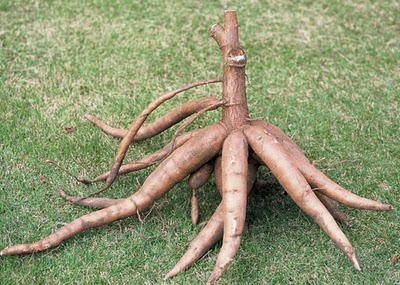
Manioc Roots (fruits-veges.blogspot.com)


The edible part of the manioc plant we find in supermarkets (Manihot esculenta) is a large root. Similar to the sweet potato, this is a storage root also called a tuber. The roots of manioc are harvested from plants 1- 5 meters tall; these shrubs belong to the Euphorbiaceae family of plants. In the tropics, manioc plants are typically found in people’s gardens and cultivated for small-scale use. 

Manioc (also known as cassava, yuca, or mandioca), may not be well known in Canada or the United States, but it is a dietary staple for people living in the tropics. In fact, next to wheat and rice, manioc contributes more to the diet of people living in the tropics than any other food.

Indigenous people have practiced manioc cultivation for millennia. The manioc domestication process began in South America somewhere between 5,000 and 10,000 years ago. Much later, around 400 years ago, manioc was introduced into West Africa.
Edible Manioc Roots 

There are many different manioc varieties and indigenous peoples in Latin America may manage the cultivation of 100 or more varieties at a time (here in North America we likely only see one of these varieties). Some varieties of manioc are bitter and some are sweet. The bitter varieties are toxic for human consumption if eaten raw because they contain cyanide. Indigenous peoples have devised various systems to detoxify these bitter varieties of manioc. One such system involves the roots (tubers) being peeled, grated (like you would grate cheese), and the pulp placed into cylinder shaped containers. These cylinder containers are hung with a heavy weight attached to the base. The weight attached to the containers serves to compress the manioc pulp and expel any toxic juices. Once the toxic juice is removed, the manioc pulp can be washed and roasted, and prepared in many different dishes. In Brazil, for example, manioc pulp is made into flour (farinha) and used to make bread or tapioca. In Ghana, manioc is made into a paste (fufu) and served with many dishes, much like rice elsewhere. In many countries manioc is also fermented and used to make beer.

One of the reason’s manioc is an attractive food source is that it is easy to grow. It tolerates drought and infertile soils, recovers quickly from pest damage, and can be planted at any time of the year. While living in Costa Rica, I was always surprised with manioc’s heartiness when I found manioc plants in unexpected places, such as abandoned fields or roadsides.

Although manioc is high in calories, it is low in protein, vitamins A and E, iron and zinc. Considering manioc’s role in meeting the needs of many people, it may not be a surprise for me to tell you that research is underway to modify the nutritional content of these plants. This research is funded by the Bill & Melinda Gates Foundation and Monsanto, and is an attempt to genetically engineered manioc varieties that are relatively high in iron and zinc.

Monsanto’s support was not provided without certain conditions. This corporation reserved the right to charge farmers for the use of these improved varieties if their income exceeds $10,000 a year.

Nutritional improvement, such as genetic engineering, is one way to address hunger, nutrition, and food security. Another is to work with people to understand some of the root causes of malnutrition, poverty, and food ‘insecurity’. As outsiders, often our perspectives of these problems are different from those of the people eating and growing plants. In planning my research, I received some wise guiding words from my Bribri (an indigenous group) colleague in Costa Rica. He expressed to me, in reference to studying how people use plants, how important it was to talk to people that use plants before making assumptions regarding what is needed to improve people’s lives. All too often, outsiders go into research with preconceived notions that indigenous people are poor and malnourished. In the case of many Bribri people, my colleague expressed this was not the case. Rather, tropical forests provide them with ample nutritious foods. More pertinent problems for the Bribri concern their rights to access plant resources in the face of rapid changes in land-use planning and property rights (e.g., intellectual property rights). This is a grave reminder that support for genetic engineering on rural people’s crops should not be granted without the guarantee that access and rights to these resources will not be lost in the process.

For those interested in trying manioc, it can be used as an alternative to potatoes or grain. In fact, 80 % of manioc’s total dry weight is edible (compared to only 35% for grain). And, even though manioc is highly perishable if left unprocessed, manioc products, such as flour and breads, can be stored a year or more. If you want to try manioc but don’t have an idea of how to prepare it, I suggest you start with fried manioc. Here is my Costa Rican recipe for yuca frita with chimichurri salsa.


Fried Manioc Recipe (serves 4):

1 – 2 manioc roots
butter and/or oil

Directions:

Using a sharp knife, cut the manioc roots in half or in three parts. Peel the waxy thick brown skin off and rinse the white inside of the root. Chop this white root into rectangle-sized pieces, a little thicker than the size of carrot or celery sticks. I boil these sticks until you can stab them easily with a fork. Drain and set aside. Heat a pan of oil at medium heat and fry the boiled manioc sticks until golden brown. If you wish to use butter add this near the beginning of the frying process. Eat the fried manioc with chimichurri or dip these manioc fries into any of your favorite salsas.

Chimichurri (Salsa):

1 tomato
1 white onion
cilantro
1 cucumber
1 juicy lime

Directions:

Dice tomato, onion, and cucumber. Add a handful of cilantro and the juice of one lime. Add salt and pepper to taste. 


Nassar, N., & Ortiz, R. (2010). Breeding Cassava to Feed the Poor Scientific American, 302 (5), 78-84 DOI: 10.1038/scientificamerican0510-78

Heckler, S., & Zent, S. (2008). Piaroa Manioc Varietals: Hyperdiversity or Social Currency? Human Ecology, 36 (5), 679-697 DOI: 10.1007/s10745-008-9193-2