Showing posts with label Palms. Show all posts

Thursday, 12 December 2013

The Ethnobotany of Costa Rica's Palms


In Costa Rica, I am known as "chica del palmito" or, the heart of palm girl. I was given this nickname by heart of palm harvesters, national park employees, and univesrity professors while conducting research for my Masters degree and some how the name stuck. But my interest in palms runs deeper than heart of palm; palms are a group of plant species that provide unique sources of food and medicine for people all over the world. In this blog post, I will share a few ways people use palms for food, not only did I study this topic for my Masters research but it was also a part of my Ph.D. For more information on how people use palms, check out our article here.

Eating palm flowers 

Palm inflorescence on top of chopped heart of palm
Palm flowers are edible. But, because palm flowers are often very tiny, people harvest and eat the whole flowering structure, called an inflorescence (see picture on right). So instead of having palm flower salad, you can strir fry, boil, or roast the whole inflorescence. One of the species commonly eaten in rural costa rica is Chamaedorea tepejilote.

While working with Indigenous people in Costa Rica, I learned that people eat palm flowers from many palm species. My favorite palm flower dish was prepared with inflorescences from the versatile peach palm (Bactris gasipaes; pictured above). I first tried this dish while living with a Bribri family and learned the dish was a favorite of Bribri Elders. I like the fact that palm inflorescences are edible because palms produce many of them in their lifetimes; and, you do not have to chop down a whole tree to harvest them. I do require help, however, to harvest an inflorescence for palm species that grow tall. In the case of peach palm, chopping down an inflorecence requires a large pole and it requires careful attention to the stiff peach palm spines that can easily make harvesting unpleasant.  


Drinking Palm wine 

Making wine usually takes a lot of work, from smashing the grapes to fermenting the final product. But palm wine, on the other hand, can be harvested directly from the plant and does not require too much extra processing. Palm wine is basically the natural sap of the palm which is harvested and left to ferment. 

Harvesting palm wine from the Coyol palm (Acrocomia aculeata) is popular in the Pacific side of Costa Rica as well as other areas of Central America. But, to harvest quality palm wine, farmers explained to me that you must work in concert with lunar cycles. To ensure a good harvest of wine you should extract palm sap three days before or after a full moon. 

I first tried palm wine while driving through the Guanacaste province of Costa Rica. During March and April you can buy this wine along the road side, but I chose to seek out a family who produced it at their home. Back in 2008, I was invited to join this family for a cold glass of off-white coloured palm sap. I had two options, with or without sugar. I opted for wine with no sugar added and surprisingly it had a sweet and tart taste. The idea of palm wine reminds me of maple syrup because it is a product produced entriely by a plant and its consumption requires only modest processing by people.

Eating palm hearts

Palm hearts are a unique food that are harvested from the inside of a palm tree stem. Large-scale palm farms can be found in Ecuador, Costa Rica, and Brazil and these farms supply canned heart of palm to supermarkets all over the world. Eating farmed heart of palm is like eating farmed bananas, these species are grown to be harvested and exported. 

The most commonly farmed palm species is the peach palm (Bactris gasipaes). But, in the tropics you can feast on multiple species of palm heart each with their own unique flavour. Some species are bitter and others are sweet, some even taste rich like butter. Many of these palm species are wild. Eating wild palm species is an activity that rural peoples have done for hundreds, or in some cases, thousands of years. Unfortunately, eating these unique wild species has caught on with some upscale businesses in Latin America and resulted in uncontrolled harvesting of wild species. 

In Costa Rica, I worked on the issue of uncontrolled harvesting of palms that occur in forest areas. This is a particularly complex issue. Palms are often harvested from protected forests and by Costa Rican law this is illegal. This makes sense to me for people who are harvesting bags of hundreds of palm hearts to sell in high end restaurants; it does not make sense, to me, for people who harvest only a few palms to eat with their families. Currently, to my knowledge harvesting foods in protected forests in Costa Rica is still illegal and this is something that I have been analyzing with Indigenous peoples as part of my Ph.D.

Tuesday, 2 July 2013

Cultural Uses of Coconuts in Zanzibar


I welcome a guest post from Sarah Halpern; at the end of the post is a beautiful photo journey of how Zanzibari people craft rope out of coconuts. 


My name is Sarah Halpern and I live in Charleston, South Carolina.  I work for the International Society of Ethnobiology.  I recently spent time studying the coconut palm in Zanzibar, Tanzania.

While traveling throughout Zanzibar, I quickly realized that much of the economy and tradition of the area relies heavily on the coconut palm. It is the most sustainable tree in the world. The coconut palm is used in almost every occupation, domestic uses, cooking, and various traditions.  My study took place primarily in the Northwestern Region of Unguja Island in Zanzibar in the villages of Mangapwani, Bumbwini, Fujoni, and Zingwezingwe.

There are disputes concerning how the coconut palm arrived in East Africa. It is believed to have originated in the Southwest Pacific and introduced in Madagascar by sailors in the 1st century AD.  It is also speculated that it was brought to Zanzibar by Arab traders and other sea faring travelers for sustenance and commercial use. Both travelers and locals have been utilizing the sweet, naturally desalinated, and uncontaminated drinking water of a coconut in the tropics for centuries. Additionally, many wild species have been found on the fringes of the Indian and Pacific Oceans implying that the tree could very well be indigenous to East Africa.  This particular idea is supported in “Perplus of the Erythraean Sea,” written in 60 AD, in which Perplus mentions the town of Rhapta, located off of the coast of present day Tanzania, where coconuts were used for trade.The name of the town, derived from the Greek/Arab word “to sew,” came about because the Arab boats were sewn together using coconut fibers.  In fact, the entire ship, the hull, masts, ropes, stitches, and even sails, was once made entirely from coconut products.  

In Zanzibari tradition, various parts of the coconut are used throughout one’s life cycle.  At the very beginning of life, a new born is blessed with coconut oil to ask God for blessings and property.  Throughout life, coconut leaves are used to make fences for various celebrations, such as weddings.  And finally, the coconut water is used to cleanse corpses before burial.

One of the most profitable professions in Zanzibar is the ownership of a shamba, an area of land covered by coconut palms.  This profession is acquired by Islamic Laws of Inheritance, meaning mostly by men. The men are responsible for hiring people to harvest the coconuts, which are then sold to various markets. Harvesting is done by using small ropes to climb the trees and cut down the fruit.They are known for singing a song about strength while climbing.  I found that most of the shamba owners in that area did little to no planting of trees on their land. 

Stonetown, the main port city of Zanzibar, is also known for its elaborate wooden doors made from the wood of the coconut palm. Therefore, carpentry is a traditional profession, passed down usually within the family. The leftover wood from the carpenters is usually used to make limestone, which can be used for building and painting.

Another traditional practice by men in Zanzibar is the domestic handicraft of upawa (seen below), a spoonlike creation used for cooking.  The coconut palm plays a large role in cooking in general as well.  The coconut is a staple in Swahili diet. It is considered the “soul food of the tropics.” The coconut palm is also used in the actual cooking process.  Trunk and coconut husks are collected and used as fuel, fish is often placed on folded coconut leaves, nyaliyo, rather than directly over a fire, in order to obtain more flavor and to prevent the fish from burning.  The stem of the leaf can be used as a stake to hold fish and vegetables over a fire as well. The leaves from the tree were once very helpful in drying out cassava, however this is not practiced anymore because whole palm leaves are more difficult to find.

The coconut and other parts of the tree are commonly used in recipes. Shredding the coconut meat, mixing with water, and straining multiple times make coconut milk, which is combined with many main courses. Coconut milk can also functions as a replacement for oil because of its high fat content. Kitale, the white coconut leaf bud is eaten like a vegetable and mixed into salads. Mbata, an overripe coconut, is also eaten as a delicious snack. Mbata, however, have become more difficult to find because of the overharvesting of coconuts.

A traditional job amongst women in the villages of Zanzibar is the creation of roofing materials for all homes, hotels, and fences. This is a particularly high paying job, however leaves are in constant demand and the profession is becoming more popular, creating a sense of negative competition among women.  

However many women also have taken part in the traditional ways of making rope. This job brings a great amount of pride for women as it is very physical. Women bury the coconut husks for a year in mud covered plains, then dig up the husks and beat them until they are broken down into string. The string is then carried home on large bulks to be twisted into rope. This process is shown below:
 A shamba owner hires a man to de-husk the coconuts from his land.

 An elderly member of the village makes a living by using a small piece of rope to climb trees 30-40 ft high to cut down the coconuts.
Upawa - a spoon like tool made from various parts of the coconut.  Made by men, but used more so by women in the Zanzibari kitchen.
A Zanzibari woman digging up her coconut husks from the "desert."  This is the first part of the rope making process, a profession done by women.  The husks are left to soak in the mud for a year to soften.

This is the second part of the rope making process where women beat out the soften husks into thin string.

The final part of the rope making process is done from the home. Women carry back the large piles of string and tie specific types of knots to make strong rope. This rope is used for everything from fishing, packaging, etc.

Saturday, 16 February 2013

Red Palm Oil: Biodiesel, Food, and Orangutans

Oil palm fruits, courtesy of Mark's Fruit Crops
Yesterday a red oil caught my eye at the health food store. Red Palm Oil. 

I had never seen anything like it, unless...could it be the same oil I saw being refined on the pacific coast of Costa Rica? After a little research, I learned this red oil was the same oil. It comes from the African Oil Palm. If you have taken a trip around Costa Rica's Manuel Antonio beach you will have seen these palms.

Before yesterday, I didn't know this red oil was used for cooking. I was only familiar with its use as a biodiesel (diesel made from animal or vegetable oils). Biodiesel is one of the reasons Costa Rica is growing these palms. In the Costa Rican countryside I've been intrigued by rickety trucks whose beds are filled with the oil palms' bright red fruits. These oily fruits are hauled to mills to be refined into oil that can substitute diesel. 

On one occasion I passed an oil palm plantation with a few friends who were on vacation in Costa Rica. My friends commented on how they knew they were in the tropics because of all the palms decorating the landscape. My friends were right, these palms are from the tropics, but not tropical America. These are native to West Africa and commonly called African oil palms (Elaeis guineesis). 


I'm still curious why these palms' fruits are used for fuel. The fruits don't look that big, they are only slightly larger than an acorn. It seems it would take a lot of fruits to make enough oil to fuel anything. But, to my surprise it appears these fruits do produce large oil yields, this is because they produce a lot of fruits all year round. So if you have palms you have oil. Another reason this red oil was suggested as a popular fuel is that the economic cost of producing palm oil is less than that of crude oil. Although palm oil has promise as a greener alternative to crude oil, it looks like it is not green-enough to make it full-swing on the oil market. 

There has been no problem however, selling red oil on the food market. It appears red palm oil - not to be confused with coconut oil -  is the world's most consumed vegetable oil. This was news to me.
Oil palm plantation, courtesy of WikiSabah News
Is palm-oil an environmentally-friendly diesel or food crop? Environmental advocates say no to either. Palm oil plantations use a lot of pesticides. And, like I saw in Costa Rica, they require a lot of land. I remember driving for more than an hour with nothing but oil palms in sight. Growing oil palms as a cash crop for export is no different than growing other plants such as sugarcane, soy beans, or bananas; the more you can fit in an acre the better. But, the more plants you pack into an acre and the more pesticides you apply, the faster the soils lose nutrients and the faster the lands will degrade. 

Poor land-use practices are characteristic of growing cash-crops to sell on the international market. But, these poor-land use practices did not catch people's attention on a large scale until the orangutan got involved. An outcry went global when people realized rain forests were being cleared to make room to plant oil palms in Borneo and Sumatra, and these lowland forests are the only place you'll find the orangutan. 

If oil palm plantations are not environmentally or orangutan friendly, why haven't people stopped farming oil palms?

Researchers from the School of Economics at the University of Queensland say it all comes down to money and this palm is making a lot of it. So, we shouldn't expect to see its plantations disappear anytime soon. Fortunately, researchers have been thinking about alternatives to ease the orangutan-oil palm conflict. For example, there has been recommendations that governments only allow people to grow palms on lands previously used for agriculture, not in orangutan-inhabited forests. But, as I see it, the future for orangutans does not look too bright.

Is there any red palm oil worth eating?

As with many foods, there are different ways to make them, some more sustainable than others. Although the large-scale oil palm plantations don't seem to be environmentally friendly in Costa Rica or in Borneo, the oil palm has been cultivated sustainably elsewhere. As I mentioned earlier, this plant is native to West Africa and people there have harvested its oil for centuries in non-contaminating and traditional ways. 

The red oil I found was produced organically in Brazil and the company's website states it was done in a sustainable manner. Palm oil is reported to be rich in vitamin E, carotenoids, and healthy fats. For me, the health benefits don't outweigh the carbon footprint incurred by importing this oil to North America, although I do look forward to tasting it somewhere where it is produced locally. 

For more info:

Swarna Nantha, H., & Tisdell, C. (2008). The orangutan–oil palm conflict: economic constraints and opportunities for conservation Biodiversity and Conservation, 18 (2), 487-502 DOI: 10.1007/s10531-008-9512-3

Monday, 10 December 2012

Eating in the Forest: 2012 Highlights


I am back in North America, breathing the fresh and cool air, after an adventure-filled year in tropical Costa Rica. Although I am recuperating from changing seasons, a diet change is by far my most interesting adjustment. As I re-experience winter comfort crops, I reminisce about how different my diet was only days ago when I was foraging in and around a lush tropical rainforest.

Here are my 2012 forest food highlights (all are organic!):


1. CHOCOLATE
Cacao beans - these seeds can be eaten or ground into a paste to make hot chocolate, we flavoured it with fresh ginger.


100% pure cacao - this hand-ground paste is ready to be boiled into pure hot chocolate.

2. PEACH PALM

Peach Palm fruit - these fruits are hung over a wood burning fire to give them a smoky and nutty taste.


Photo by Edder Francisco Diaz Segura
The whole peach palm is edible. I'm holding the inflorescence (eaten roasted) and the heart of palm and young flowers (white material) are cooked in this large green leaf.

3. BANANAS

Purple bananas - it is more sweet and filling than a standard yellow cavendish; Purple bananas are also the special ingredient in Armadillo stew.
One versatile banana - this sweet dessert banana can be eaten as a snack or boiled when unripe to add to a meal; here I was eating this banana with wild greens and eggs.


Roasted bananas - my favorite afternoon snack with a cup of hot chocolate.

4. SIMPLICITY

Stone-ground corn (we did the grinding by hand) - how often can you make corn tortillas or cornbread from scratch? All you need is corn, water, and a couple stones.
Simple yet satisfying


Wednesday, 8 February 2012

Food in Unsuspecting Places: Not Fruit, Nor Flowers, but Unripe Palm Inflorescences


In the process of finding a place to begin my research, I have been fortunate to experience a taste of life in farmland surrounded by tropical forests. I was particularly intrigued with the food I found in unsuspecting places.

I’m sure we’ve all experienced trying a new food either while travelling or even from our own backyard. In my garden, I have often discovered something thought a weed was in fact edible. My most recent unique food experience was on a visit to an organic farm, La Finca Agroecologica El Progreso, in the Caribbean Region of Costa Rica near Tortuguero National Park. Because of my interest in plants and particularly in their different uses as food, I asked my host, Nuria, to take me on a short walk to see the foods growing in her garden.

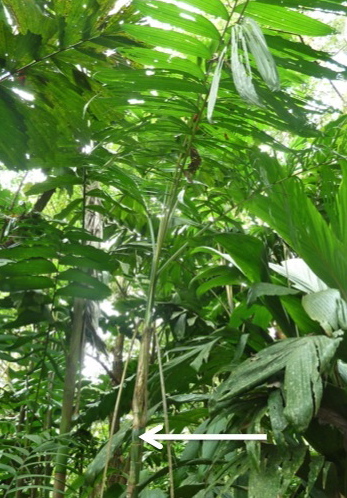
Chamaedorea tepejilote Palm (the arrow is pointing to the edible inflorescence growing on the stem)

Walking only a few hundred meters from Nuria’s house, to my surprise, I found myself in a patch of dense tropical forest. This was not your typical garden that’s for sure. In fact, it was a pasture that had been converted to a forest patch through the dedicated effort and creativity of these farmers. As I marveled at the colourful tropical flowers and fruits, Nuria drew my attention to a skinny green palm tree. At first glance I thought was she was showing me an edible species of heart of palm. Heart of palm is a well-known source of food harvested from the inside of a palm tree stem and often used in salads. But, after a closer look, this palm tree was much too skinny to produce a ‘heart’ worth harvesting. Sure enough, Nuria was not interested in the heart of palm; instead, she pulled off a few green fleshy spikes from the top of the palm stem. She explained that these fleshy spikes were the unripe inflorescences of the Chamaedorea tepejilote or Pacaya palm.

Freshly harvested Chamaedorea spikes or unripe inflorescences

Now I bet you are thinkng, just what exactly is an unripe inflorescence? Let’s start with an inflorescence, which is a plant structure where a bunch of flowers develop; kind of like a stem to support multiple flowers.  Perhaps the best way to explain an inflorescence is to look at a sunflower. As its name suggests a sunflower may appear to be a single flower, but a closer look reveals that one sunflower is a bunch of tiny flowers all growing on a single structure known as an inflorescence. Each one of these tiny flowers produces one sunflower seed. If you get the chance to pick sunflower seeds you are picking them from multiple flowers on one inflorescence. Thus, what we commonly call a ‘sunflower flower’ is actually a ‘sunflower inflorescence’. Now, if an inflorescence is a plant structure where the flowers will eventually develop, an unripe inflorescence is simply a flowerless ‘fruit and flower’ stem.

A Sunflower Inflorescence - here you can see the seeds developing within each tiny flower (photo by bixentro under the Creative Commons Attribution License 2.0)

Ok, back to the topic at hand, what were we going to do with these unripe palm inflorescences? I have eaten fruits, and even flowers in a salad, but what dish could become of unripe flower stems? Back in Nuria’s kitchen we were soon to find out. First, we peeled the palm inflorescences and began cooking.

Peeling the Chamaedorea spike - the edible portion is found inside the green casing

Nuria told me of many different recipes and uses for this delicacy. For example, you can roast the inflorescence in its casing and enjoy it on its own, or you can chop the inflorescence along with spices and other veggies in a Costa Rican dish called picadillo. This particular day Nuria shared her personal favorite, a sautéed mix of these inflorescences and Chayote squash. This simplicity of this option allowed me to experience the true Chamaedorea inflorescence flavour.

Now to the hard part, describing the flavour. I guess I would describe it as slightly bitter with a texture similar to that of cauliflower. Chamaedorea’s bitter flavour reminded me of another species of palm called súrtuba. Súrtuba (also the subject of my Masters research) can be found in Costa Rican cloud forests and this palm is harvested for its bitter tasting heart. For those not familiar with súrtuba, the Chamaedorea inflorescence flavour was also similar to that of cooked Yucca flowers (or Flor de Itavo). Something tells me these comparisons are not much help; maybe the lack of well-known foods to compare to Chamaedorea is an indication this food was unique.


During lunch, I was pleasantly surprised that the Chamaedorea inflorescence was the perfect complement to the mild flavour of the Chayote squash. I don’t know what exactly converted me to a fan of eating unripe palm inflorescences. Maybe I’m a fan of bitter and interesting foods. Most probably, it was the fact that we simply walked into a forest patch and picked this unsuspecting green spike for lunch. Either way, I entered this venture with a palm-bias and left with a greater appreciation for the multiple uses of this incredible group of plants.

Tuesday, 19 July 2011

Heart of Palm


What most of us know as ‘heart of palm’ are these cans of white stalks. Often prepared for salads, these vegetables have made their way on to plates all over the world. For most of us, the origin of these unique vegetables is a mystery.  At least, it was to me before I first traveled to Costa Rica.  Little did I know, after only few months into my journey, I would be devising a research project based on this unique food.


You can find fresh hearts of palm in the tropics.  As the name suggests, this delicacy comes from the inside of a palm tree stem. What may come to mind is a picturesque sunset with a few tropical coconut palms on the horizon, but the majority of heart of palm you’ll find in the grocery store is produced from a different palm species, the only one that is cultivated - the peach palm.  Compared to the emblematic coconut palm, the peach palm stem is smaller and produces tiny fruits.  Peach palm fruits (or pejibaje in Spanish) are edible and delicious! Their flavour is difficult to describe, slightly reminiscent of a butternut squash but much richer and with a fibrous texture.

Peach Palm Fruits
(photo courtesy of C. Manchego)


Peach palm is found all over Latin America, but North America imports this product primarily from farms in Ecuador. Peach palm plantations look a lot like tree farms, or rows of cultivated plants. Peach palm trees grow surprisingly quickly.  It is estimated that in one year (give or take a few months) one stem will be ready to eat.


Still, how do you go from palm tree to the small white stalk on your plate?

Like any canned vegetable, peach palm processing has multiple steps. First, the stem is cut, sliced open, and its ‘heart’ is removed from the tip of the stem.  Although canned palm hearts are then processed and preserved, many people will eat the heart of palm raw freshly cut from the stem! Here is a quick video of how cultivated palm trees are processed:


One peach palm plant produces multiple stems. Confusing, I know, but it just means that from one palm seed you can get many trees growing in one clump. This is ideal species for palm farming because you can obtain numerous hearts of palm from a single palm plant.

What about all the other palms? 


Interestingly, peach palms, along with many other palms, have been harvested for food in the tropics for hundreds, possibly thousands, of years.  However, the idea of a palm at a North American dinner table is a relatively recent phenomenon, it wasn’t until the mid-20th century that a few species entered into the international market. 


Although only a few palm species make it into the international market, there are approximately 2500 species of palms in the world, and all of them are likely to have ‘hearts’. Here is one example of a heart of palm harvested from the cloud forests of central Costa Rica. This particular species is valued by many Costa Ricans for its ‘bitter’ taste.  Some also report it for medicinal properties.

Cloud Forest Palm > 2000 masl (Geonoma edulis)

Harvested Palm Stem

Palm Hearts (removed from the tip of the stem)


Although the majority of the 2500 palm species are not harvested, more than 10 non-cultivated species are harvested in Costa Rica alone. Although my uncle thinks that the world already has one too many ‘palm-ologists’, I think this group of plants is ripe for further study. My experience with these diverse plants has opened my eyes to the importance of unique forest species to the daily lives of many people. I suppose palm-ology is one of the motivations for starting this blog and it has influenced the research I am involved in now. In part II, I’ll share my experiences with Costa Ricans who harvest some of the less well-known and harder to find species of palms.

Sources:

Mora-Urpí, J. 2002. Presente y futuro del palmito en Costa Rica. Agronomía Costarricense 26(2): 95-100.

Sylvester, O. and Avalos, G. 2009. Illegal palm heart (Geonoma edulis) harvest in Costa Rican national parks: patterns of consumption and extraction. Economic Botany 63(2): 179-189.