Wednesday, 8 February 2012

Food in Unsuspecting Places: Not Fruit, Nor Flowers, but Unripe Palm Inflorescences


In the process of finding a place to begin my research, I have been fortunate to experience a taste of life in farmland surrounded by tropical forests. I was particularly intrigued with the food I found in unsuspecting places.

I’m sure we’ve all experienced trying a new food either while travelling or even from our own backyard. In my garden, I have often discovered something thought a weed was in fact edible. My most recent unique food experience was on a visit to an organic farm, La Finca Agroecologica El Progreso, in the Caribbean Region of Costa Rica near Tortuguero National Park. Because of my interest in plants and particularly in their different uses as food, I asked my host, Nuria, to take me on a short walk to see the foods growing in her garden.
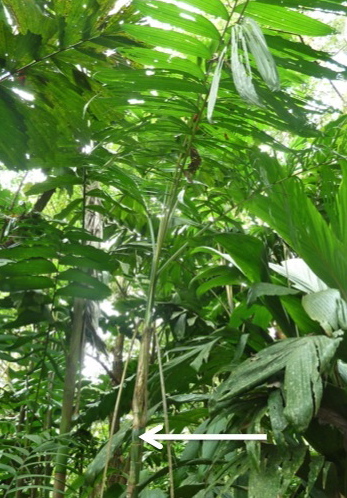
Chamaedorea tepejilote Palm (the arrow is pointing to the edible inflorescence growing on the stem)

Walking only a few hundred meters from Nuria’s house, to my surprise, I found myself in a patch of dense tropical forest. This was not your typical garden that’s for sure. In fact, it was a pasture that had been converted to a forest patch through the dedicated effort and creativity of these farmers. As I marveled at the colourful tropical flowers and fruits, Nuria drew my attention to a skinny green palm tree. At first glance I thought was she was showing me an edible species of heart of palm. Heart of palm is a well-known source of food harvested from the inside of a palm tree stem and often used in salads. But, after a closer look, this palm tree was much too skinny to produce a ‘heart’ worth harvesting. Sure enough, Nuria was not interested in the heart of palm; instead, she pulled off a few green fleshy spikes from the top of the palm stem. She explained that these fleshy spikes were the unripe inflorescences of the Chamaedorea tepejilote or Pacaya palm.

Freshly harvested Chamaedorea spikes or unripe inflorescences

Now I bet you are thinkng, just what exactly is an unripe inflorescence? Let’s start with an inflorescence, which is a plant structure where a bunch of flowers develop; kind of like a stem to support multiple flowers.  Perhaps the best way to explain an inflorescence is to look at a sunflower. As its name suggests a sunflower may appear to be a single flower, but a closer look reveals that one sunflower is a bunch of tiny flowers all growing on a single structure known as an inflorescence. Each one of these tiny flowers produces one sunflower seed. If you get the chance to pick sunflower seeds you are picking them from multiple flowers on one inflorescence. Thus, what we commonly call a ‘sunflower flower’ is actually a ‘sunflower inflorescence’. Now, if an inflorescence is a plant structure where the flowers will eventually develop, an unripe inflorescence is simply a flowerless ‘fruit and flower’ stem.

A Sunflower Inflorescence - here you can see the seeds developing within each tiny flower (photo by bixentro under the Creative Commons Attribution License 2.0)

Ok, back to the topic at hand, what were we going to do with these unripe palm inflorescences? I have eaten fruits, and even flowers in a salad, but what dish could become of unripe flower stems? Back in Nuria’s kitchen we were soon to find out. First, we peeled the palm inflorescences and began cooking.

Peeling the Chamaedorea spike - the edible portion is found inside the green casing

Nuria told me of many different recipes and uses for this delicacy. For example, you can roast the inflorescence in its casing and enjoy it on its own, or you can chop the inflorescence along with spices and other veggies in a Costa Rican dish called picadillo. This particular day Nuria shared her personal favorite, a sautéed mix of these inflorescences and Chayote squash. This simplicity of this option allowed me to experience the true Chamaedorea inflorescence flavour.

Now to the hard part, describing the flavour. I guess I would describe it as slightly bitter with a texture similar to that of cauliflower. Chamaedorea’s bitter flavour reminded me of another species of palm called súrtuba. Súrtuba (also the subject of my Masters research) can be found in Costa Rican cloud forests and this palm is harvested for its bitter tasting heart. For those not familiar with súrtuba, the Chamaedorea inflorescence flavour was also similar to that of cooked Yucca flowers (or Flor de Itavo). Something tells me these comparisons are not much help; maybe the lack of well-known foods to compare to Chamaedorea is an indication this food was unique.


During lunch, I was pleasantly surprised that the Chamaedorea inflorescence was the perfect complement to the mild flavour of the Chayote squash. I don’t know what exactly converted me to a fan of eating unripe palm inflorescences. Maybe I’m a fan of bitter and interesting foods. Most probably, it was the fact that we simply walked into a forest patch and picked this unsuspecting green spike for lunch. Either way, I entered this venture with a palm-bias and left with a greater appreciation for the multiple uses of this incredible group of plants.

Tuesday, 17 January 2012

From Sea to Market: Tárcoles and Artisanal Fishing


After almost two years away, I recently returned to Costa Rica. The last time I was here, I was living in the country and working on my Masters. During my Masters, I worked with communities that harvest a species of palm, Súrtuba or Geonoma edulis. This palm is known for its edible, but extremely bitter, heart of palm.


Now, I am back to learn more about rural food systems, particularly those that challenge the industrial food-production model while promoting socially equitable and environmentally responsible practices. Surprisingly, I did not have to go very far from the capital city, San José, to find a unique example of such a food production system. With the kind invitation of Por La Mar (a consortium formed by representatives of two organizations: CoopeSoliDar R. L and the fishing cooperative CoopeTárcoles), I traveled a couple of hours to Tárcoles, a small fishing village with a lot of character. 


Untangling fishing line - not an easy task
I had heard a lot about Tárcoles during my time in Costa Rica and what stood out was this town’s hospitality. I realized this welcoming spirit was very much alive after we were greeted with a ceviche and a tour of the on-land fishing activities. During a short tour along the shore, I learned how to untangle a fishing line, fix a fishing net, and I became familiar with diving, handlining, and gillnetting, the three ‘arts of fishing’ practiced in Tárcoles (see this link for more information regarding some artisanal fishing techniques). 


Coopetarcoles fish market
I saw fishing boats on the beach, fish being unloaded and carried only several meters before being weighed and bought by the locally-operated fishing cooperative. From sea to market, literally, in less than 100 meters.


Before I go any further, I should mention how much I enjoy seafood. However, years ago, I gave up eating it entirely because of the lack of transparency in the industry. On countless occasions I have asked supermarkets where a fish they are selling came from, but rarely did I get a clear answer. It is often much too difficult to find out the species of fish for sale, where it came from, and whether the fish was harvested using ecologically and/or socially responsible methods. Recently, I have incorporated seafood back into my diet but it is extremely difficult to find local sources, and most importantly, sources where the fisher benefits directly from my purchase. Tárcoles is definitely an exception to the typical model. CoopeTárcoles has managed to promote keeping jobs local, residents are hired to fix nets, untangle lines, process and sell fish, they have administrative jobs, and of course, they do the fishing themselves. Working within a local cooperative also helps assure a fisher that their product will be sold; this assurance provides valuable job security for the fisher.


So just what makes artisanal fishing different than industrial-scale operations in terms of sustainability of the catch? First, we could compare the quantity of fish taken. However, it is not simply a matter of noting that industrial fisheries catch more and supply larger markets, rather, the fishing techniques used in industrial and artisanal fishing are starkly different. For example, shrimp is the target of most large-scale fishing efforts in Costa Rica. To maximize efficiency, these boats use the trawling method of fishing. Nets, or trawls, are pulled through the water behind a large boat. To fish for shrimp, which are bottom-dwelling creatures, these nets are dragged along the bottom of the sea. As you can imagine, when you drag a large net with holes smaller than the size of shrimp along the bottom of the ocean, you are not only going to catch shrimp. Shrimp trawlers catch almost everything (see these links for concerns about sea turtles and other marine megafauana getting caught in shrimp trawling nets).
For all of us who love to eat shrimp, understanding the sustainability of shrimp fishing should give us some food for thought. One alterative to supporting large-scale shrimp-fishing operations is to purchase shrimp from more sustainable sources (see this link for alternative shrimp fishing in British Columbia or for more selective trawling techniques).

Trawlers
In Tárcoles, fishers do not use nets with holes smaller than three inches. Using nets of different sizes allows fishers to discriminate and select for larger fish. Selective fishing allows fishers to leaving behind juveniles, which are too small to be sold on the market. Fishers explained that industrial fishing for shrimp, with their small mesh sizes, results in the elimination of juvenile fish stocks. This removes future reproductive individuals from the population.
Gillnetting
There is one more piece to this story that left a lasting impression on me. After only one afternoon at sea with a couple fishers I realized it was not just the net or the fishing line that lessened the ecological fishing impacts, it was the experience and vision of the people. Fishers expressed the importance of a community-created buffer zone in the ocean where only handline fishing is permitted. In other words, no large-scale shrimp trawlers could enter this zone. Limiting fishing to handlining is one way to lessen the impact of fishing in and around the shore, which is an important breeding area for certain fish species. There is currently a one mile temporary buffer zone, but fishers are in favour of maintaining a permanent buffer zone and expanding its size. One of the reasons mentioned was that although industrial shrimp trawlers catch almost everything, this industry rarely uses anything other than the shrimp.  


One mile buffer zone


My experiences in Tárcoles have shed more light on the concepts of food security or food sovereignty than any definitions I’ve read about. For example, through community-level initiatives, people from Tárcoles have created a buffer zone to protect fish stocks and secure access to food sources. This buffer zone does not exclude people from fishing, but rather it promotes lower impact fishing techniques and resists more wasteful trawling operations. One fisher told me that this buffer zone is an example of a place anyone can fish; however, there is one catch (pun intended). That is, all those who fish within the buffer zone should respect the sea and other people that use it. In fact, this fisher’s comment shows that Tárcoles is an example of more than just securing food sources for all people at all times, it is a transformative process. Tárcoles, and the fishers within this community, stand in stark contrast to a sea full of industrial-level fishing operations that benefit few people, respond to unrealistic demands for food, and create an exported food product. For most potential consumers of this product, which can appear on shelves anywhere in the world, it is almost impossible to tell where the seafood came from, how it was produced, and most importantly, whether buying it is consistent with their principles. As we talk about alternatives to industrial food production we should contemplate examples like Tárcoles - an area and a people who are making an effort to recreate autonomous or sovereign food systems based on equitable and ecologically-sustainable practices. 
Consortium Por La Mar